My Mortar and Pestle Articles Are Answering Google's AI
For a few years now, I have had two articles floating around the internet about how to choose the best mortar and pestle. One was for Cookly Magazine, where I wrote articles and edited submissions for other writers. The other was for KROK, a brand that makes handcrafted granite mortars and pestles. I wrote them, published them, and mostly forgot about them. They ranked well, brought in traffic, and did their job.
Last week, I searched "how do I choose the best mortar and pestle to buy" on Google. As you know, the top results no longer show links to websites, but an AI answer. And my articles were sitting right inside it. The AI pulled material recommendations from the Cookly article and size and shape advice from the KROK article. Two different brands, one AI answer, zero clicks required.
AI’s answer on How to Choose the Best Mortar and Pestle to Buy
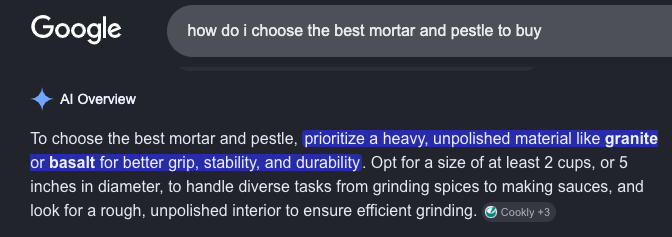
The AI Overview states: To choose the best mortar and pestle, prioritize a heavy, unpolished material like granite or basalt for better grip, stability, and durability. Opt for a size of at least 2 cups, or 5 inches in diameter, to handle diverse tasks from grinding spices to making sauces, and look for a rough, unpolished interior to ensure efficient grinding. Cookly +3
The section about size and capacity shows this:
Weight: Heavier is better. A heavy set will not slip or slide on your counter when you are putting in effort.
Shape: Look for an unpolished, porous interior to create friction. The bowl should be rounded to avoid ingredient trap, allowing for smoother grinding.
Pestle Design: The pestle should be long enough to keep your hands comfortable and have a wide enough head to tackle ingredients efficiently.
krokcraft.com +4
What This Means for SEO
Five years ago, the goal was to rank number one. You wrote content, optimized it, built backlinks, and prayed for the top spot. A click was the only way anyone would read your words, find your products. But this is no longer true.
Today, your content can appear inside Google's AI Overview without anyone clicking. Google reads your article, extracts the most useful information, and presents it directly in the search results. If you aren’t writing content that answers specific questions clearly and authoritatively, you’re not being considered for these AI-sourced answers. And if you’re not being considered, someone else is.
What Google's AI Seems to Favor
Based on these two articles, Google's AI tends to pull from content that answers a specific question directly and early, uses clear and structured formatting like lists and bold text, comes from a source with demonstrated authority on the topic, and provides actionable, specific advice rather than vague generalities. My Cookly article answered the material question first. My KROK article answered size and shape with bullet points and clear headers. Google's AI pulled both.
Why This Matters for Your Business
If you’re a brand creating content, your ROI is no longer measured only in clicks and conversions. It’s also measured in visibility inside AI answers. A potential customer may never visit your website. They may read your words inside Google's AI Overview, get the answer they need, and move on. That’s fine. But if that answer came from your content, you just built trust. And trust leads to clicks later, even if not immediately.
The Rules Have Changed, the Game is the Same
The mechanics of SEO are shifting. Ranking is still important. But appearing as a source inside AI answers is becoming equally valuable. You can’t optimize for Google's AI the way you optimized for search rankings. The algorithm is different and the rules are less clear. But you can write content that is genuinely useful, clearly structured, and confidently specific. That’s what my mortar and pestle articles did. They weren’t written for AI (because they were written before AI’s domination). They were written for people trying to buy a mortar and pestle. Google's AI just happened to agree that they’re useful.
Your Move
If you’ve been writing content for years, keep going. You may already be inside AI answers without knowing it. If you’re just starting, write for humans first. Answer real questions. Be specific and be helpful. The clicks may come eventually but the trust starts now.
