The Luang Prabang Test: What This City Taught Me About Honest Travel Copy
The night market in Luang Prabang opens at 5pm, and by 5:15 the main street is a river of backpackers. Twenty-year-olds in elephant pants haggling over hemp bracelets. Retired Europeans in linen shirts examining silk scarves. I stood there with my wife, expecting the usual tourist trap, the facade that hides the real city behind it. That's when I noticed the embroidery.
A Hmong woman sat cross-legged behind her stall, stitching a pattern she learned at age seven. Her daughter sat beside her, learning the same stitches. The scarves weren't made for tourists in a factory somewhere. They were made here, by hand, using techniques that predate the French colonial buildings lining the street. I bought one not because I needed a souvenir, but because I finally understood what I was looking at: economic survival and cultural continuity in the same gesture.
That was the first part of what I now call the Luang Prabang Test.
The Dichotomy I Didn't Expect
Most destination copy about Luang Prabang mentions the "well-preserved French colonial architecture" and the "serene Buddhist temples." It doesn't mention the backpackers. It doesn't mention that the night market is the reason some Hmong families can afford to keep their daughters in school. It doesn't mention that the French colonial buildings are beautiful because the city values them, not because a tourism board restored them for Instagram.
The lie of omission is everywhere in travel copy. I see it every day in the booking pages I edit. "Hidden gem." "Off the beaten path." "Authentic local experience." These phrases describe a fantasy that no longer exists, if it ever did.
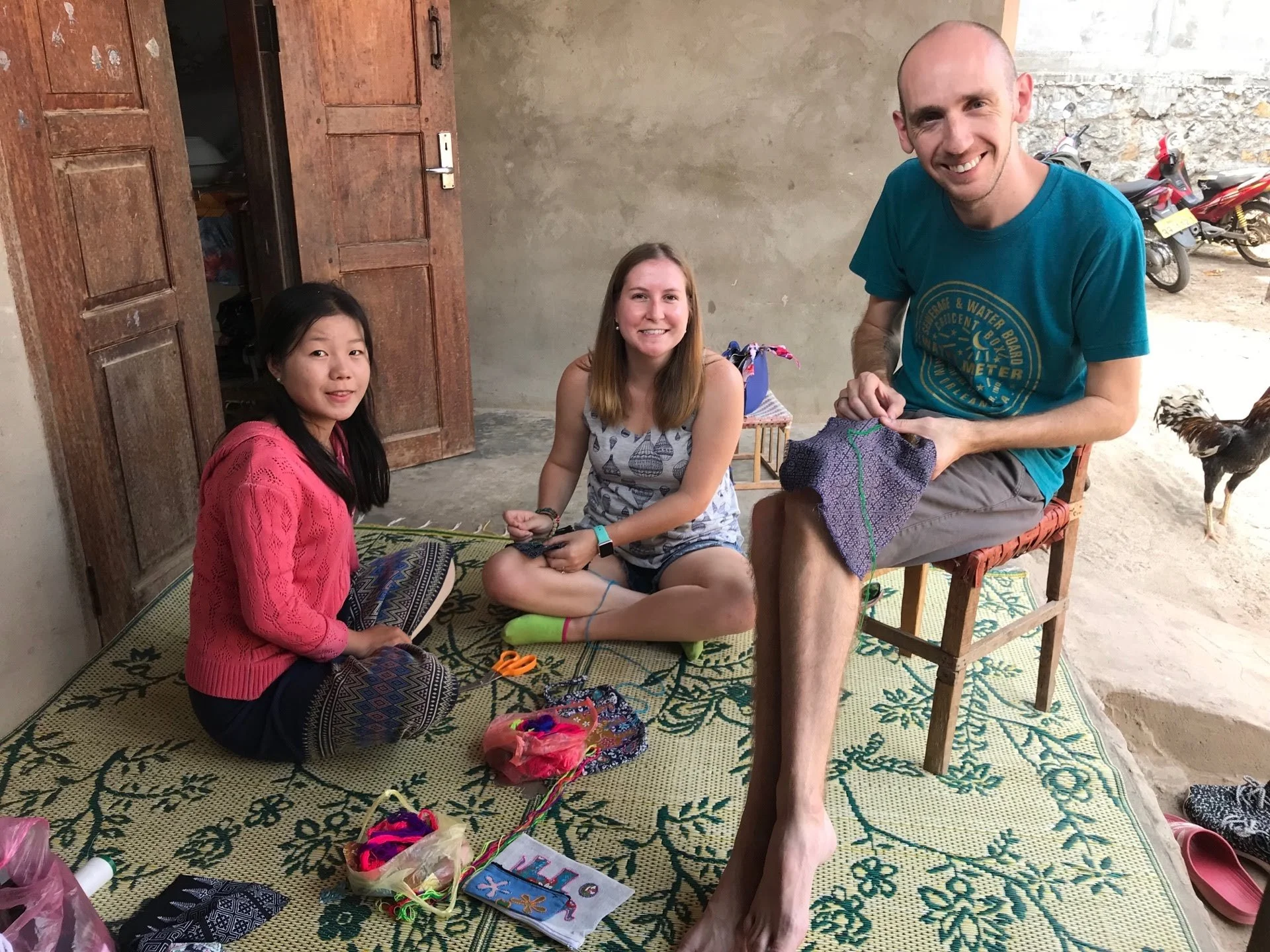
Halie and I visiting the Hmong village, March 2018
On my second day in Luang Prabang, we used Backstreet Academy (RIP) to visit a Hmong village outside the city. We spent the afternoon embroidering with two women who'd been stitching since childhood. We walked around meeting other members of the tribe, learning about their lives and language and culture. No one was putting on a show, the village wasn't a theme park. The embroidery was real, the conversation was real, and the economic need was real.
That's the second part of the test: does the copy explain why the place works with tourists, not just in spite of them?
The Meal That Changed Everything
We crossed the bamboo bridge over the Nam Khan River, only up six months of the year, taken down for the rainy season, and found Dyen Sabai on the other side. Benches and ground-level seating faced the river. The menu called it "Lao Fondue", but I learned later the real name is sindad.
A pile of hot coals. A rounded grill with a moat for broth. Raw meat, vegetables, noodles, and eggs. You start with spicy chilis and garlic in the broth, then cook the meat on the grill after greasing it with a chunk of fat. The broth was the best I've ever tasted.
The restaurant wasn't empty. It wasn't "discovered" by a single food blogger. It was full of travelers who'd been told by other travelers that this was worth the walk across the bamboo bridge. The crowd was part of the experience.
That's the third part of the test: does the copy promise something the place can actually deliver?
Applying the Test to Every Booking Page
When I edit booking pages for cooking classes in Bangkok or food tours in Ho Chi Minh City, I apply the same three questions. Does the description mention that you'll be in a group? Does it explain why the guide speaks English? Does it acknowledge that the "family recipe" has probably been adapted for foreign palates?
These are all details that build trust.
The best booking copy I've written promises specificity. "You'll learn to make pad kra pao from a vendor who's cooked it on this soi for 20 years. The recipe is hers. The spice level is yours." That line converts better than "authentic Thai cooking experience" because it doesn't ask the reader to believe in magic.
The UXO Museum and the Honest Close
We ended our last day at the UXO Museum, which chronicles the two million tons of bombs dropped on Laos between 1964 and 1973 and the ongoing effort to locate and dismantle the 80 million unexploded bombs left behind. It was a sobering end to an incredibly enjoyable weekend.
No destination guide I've read mentions the UXO Museum in the same breath as the waterfalls and temples. Most keep the heavy history separate from the "must-do activities." But the test says you can't separate them. The bombs are part of why Laos is what it is. The tourists are part of why Luang Prabang survives. The embroidery is part of why the Hmong endure.
I want to return to Luang Prabang because I know exactly what I'll find: the embroidery, the sindad, the bamboo bridge, the UXO museum, the tourists. And I know why all of it matters.
If you write travel copy, try the test. If you hire travel writers, ask for it. The best destinations are the ones honest enough to explain why the tourists keep coming.
I specialize in travel copywriting that passes the test. If you need booking pages, destination guides, or editorial that respects your readers and your destinations, view my portfolio or reach out. I'd love to show you what honest travel copy looks like.
