Zero-Click Search vs. Traditional SEO: The Travel Writer's New Tightrope
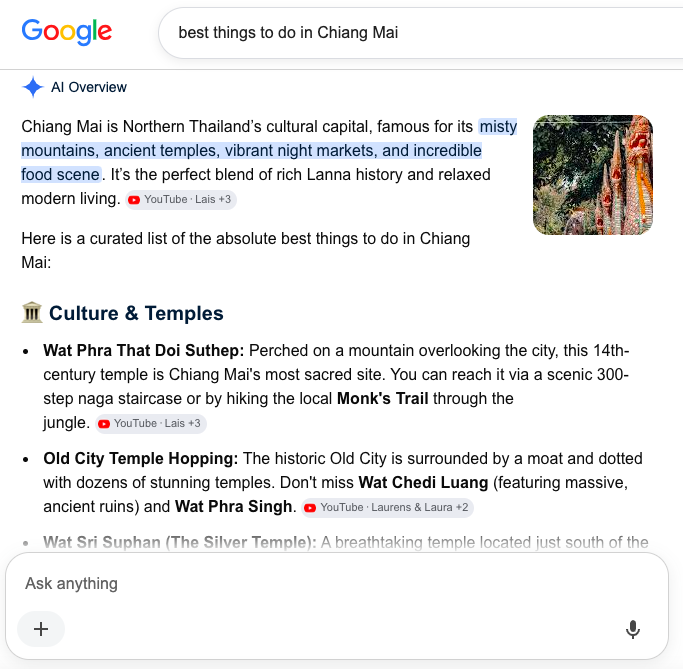
A few weeks ago, I searched for "best things to do in Chiang Mai." Google's AI Overview gave me a bulleted list before I clicked a single link. Temples, night markets, cooking classes; all summarized in 150 words. I got what I needed without visiting a single blog.
As a travel writer, that should terrify me. And it does, a little.
But it also makes me think harder about what I write, why I write it, and who it's actually for.
The Two Worlds
World One: Traditional SEO
This is the model most travel writers grew up with. You write a 2,000-word guide to Lisbon. You optimize for keywords. You add affiliate links to hotels and walking tours. You hope the reader clicks through, reads the article, and then clicks again to book something. The article is the gateway. The click is the currency.
This is the world I live in when I edit booking pages for Cookly. The entire point is to get the reader from search results to checkout. Every headline, every CTA, every paragraph is designed to move someone closer to a transaction.
World Two: Zero-Click Search
This is Google's AI Overviews, Bing's Copilot, and whatever comes next. The user asks a question. The AI scrapes the web, synthesizes an answer, and serves it directly on the search page. The user never visits the source. The writer's work is consumed, but the writer gets nothing — no traffic, no ad impression, no affiliate click.
For travel content, this is already happening. "Best time to visit Japan." "What to pack for Vietnam." "How many days in Bangkok." These are informational queries, and AI is getting very good at answering them without sending anyone to a blog.
The Crossroads
Travel publishing is caught in the middle. On one side, you have booking platforms, OTAs, and experience marketplaces that still need clicks. They need landing pages. They need conversion copy. They need someone to write the words that turn a search into a purchase.
On the other side, you have the informational content that AI is eating. The "what is" and "how to" and "best of" articles that used to drive traffic and now just feed the machine.
The question for travel writers is: which world do you write for? And can you write for both?
What Still Gets Clicks
Not everything is zero-click. AI Overviews are great for facts, but they're still terrible for experience. They can't tell you what it feels like to watch the sunrise from a fifth-floor cafe in a crumbling Ho Chi Minh City apartment building. They can't describe the smell of a night market in Taipei. They can't capture the anxiety of missing a train in Berlin and the unexpected conversation that follows.
The content that still gets clicks is the content AI can't replicate:
First-person narrative. A story with an emotional arc, specific scenes, and a human voice.
Deeply reported service journalism. Not "best hotels in Lisbon" but "I stayed in six Lisbon hotels so you don't have to and here's what each one got wrong."
Niche expertise. The kind of specific, local knowledge that comes from years of living somewhere, not from scraping TripAdvisor.
Opinion and perspective. "Why I think Bangkok's street food scene is at a tipping point" requires a point of view. AI has no point of view.
Visual and multimedia content. Photo essays, video, interactive maps. AI can describe a photo. It can't show you one.
This is why my WorldAtlas articles still work. Yes, they're listicles of towns and historic sites. But they're researched, specific, and written with a voice. Even if Google summarizes them, the reader who wants depth still clicks through. The AI Overview becomes the teaser, not the replacement.
How I Balance Both Worlds
I don't have a perfect answer. But here's what I'm trying:
1. I write transactional content with transactional clarity.
When I write booking page copy for Cookly, I'm not trying to win a literary prize. I'm trying to get the reader to click "Book Now." That means clear headlines, scannable structure, and CTAs that don't hide. This content lives in World One, and that's fine. It has a job.
2. I write narrative content with narrative depth.
When I write about returning to Ho Chi Minh City or exploring apartment buildings that look abandoned, I'm writing for the reader who wants more than information. I'm writing for the person who will read the whole piece because they care about the story. This content lives in World Two, and it's the content AI can't steal.
3. I don't write generic listicles anymore.
"10 Best Things to Do in Paris" is dead. AI will eat it. "10 Best Things to Do in Paris" with no personal angle, no reporting, and no point of view is just fuel for the machine. If I write a list, it needs a frame: "10 Things I Learned Returning to Paris for the Fifth Time." That frame is the reason to click.
4. I think about the reader's intent, not just the keyword.
Someone searching "best time to visit Japan" wants information. AI will serve them. Someone searching "should I visit Japan in November or March" wants a decision. That's harder for AI to answer with confidence, because it depends on what the traveler values. Quiet temples or cherry blossom crowds? Cold clarity or humid green? The writer who can frame the trade-off still has a job.
5. I build direct relationships.
This is the long game. If all your traffic comes from Google, you're vulnerable to every algorithm change. If your readers come because they follow you on LinkedIn, subscribe to your newsletter, or bookmark your blog, you're insulated. The travel writer's future isn't just about ranking. It's about being someone worth following.
The Honest Truth
I don't know if travel blogging as a traffic-based business model will survive the next five years. The math is getting worse. Ad rates are down. Affiliate commissions are shrinking. AI is eating the top of the funnel.
But I do know that travel writing as a craft - the act of observing, reporting, and telling a story that makes someone want to go somewhere - is not going anywhere. AI can summarize. It can't make you feel the humidity of a Bangkok alley at midnight. It can't make you want to book a flight.
The writers who survive will be the ones who write things worth clicking for.
That's the tightrope. And I'm still learning how to walk it.
What do you think? Is zero-click search killing travel content, or just forcing it to get better? Drop a comment. I'd genuinely love to hear your take.
