When I started learning Chinese, I couldn't say very much. I knew a few random nouns and verbs and could count to 10. There was no way I was building a sentence. But living in Shanghai, I learned something surprising. A single correct word, placed correctly, worked better than a dozen guessed ones. "Water" got me water. "Bathroom" got me pointed in the right direction. "Zhège" while pointing to a menu got me fed. The precision mattered more than the quantity of words.
One Word That Works
In my early months in Shanghai, I had a vocabulary of maybe fifty words. I could not make a proper sentence. But I could say "nǐ hǎo" while waving. I could say "tài guì le" while shopping. And I could say "xièxiè" and mean it. Fifty words got me through every day because I used them exactly where they belonged.
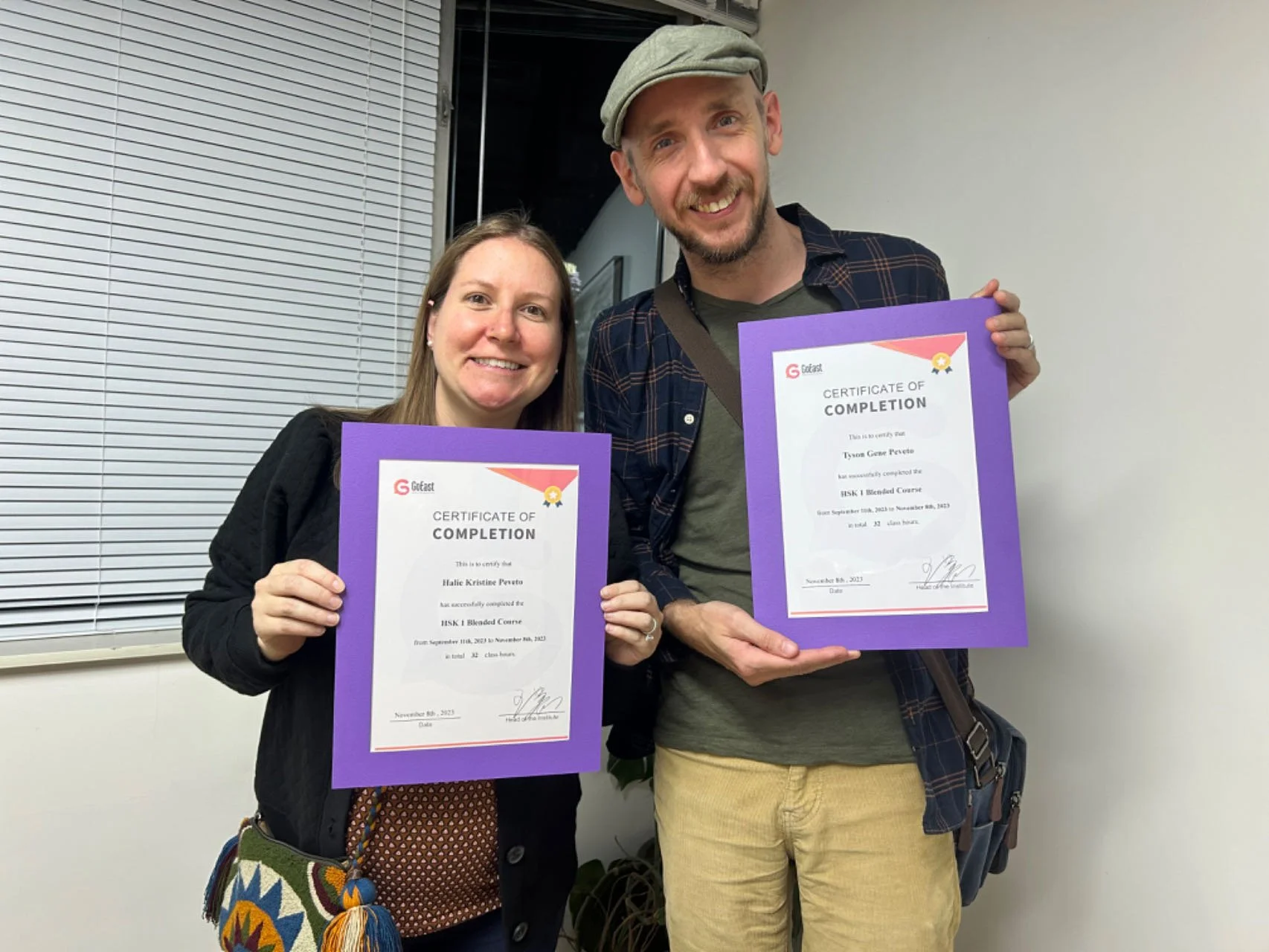
Halie and me with our HSK 1 certificate of completion.
Most copy does the opposite. It throws a dozen vague words at the reader hoping one lands. "Revolutionary." "Disruptive." "Cutting-edge." "Next generation." The reader has seen these words a thousand times. They mean nothing because they could mean anything. A single specific verb does more than three adjectives. One concrete noun lands harder than a paragraph of vague praise.
The Beginner's Mind
In my Chinese classes, I was often one of the stronger students. The temptation was to let the class move fast, to skip over basics, to assume everyone was keeping up. A good teacher resists that temptation. They slow down and they require everybody to repeat everything. They constantly check for understanding. They know that the student who is struggling will not raise their hand and say so.
Many brands write for the customer they wish they had instead of the customer they actually have. The copy assumes knowledge the reader does not possess. The jargon feels insider but lands as exclusionary. The best students are fine. Everyone else gets left behind.
Learning Chinese taught me to write for the person who knows less than I think they do. Assume nothing, define the terms, explain the context. The expert will skim and the beginner will stay. The beginner is the one you need to convince.
Respect the Reader's Time
A private lesson costs money. An app costs a subscription. A group class costs an evening. Every learning method asks something of you. Copy asks something too. It asks for attention. The reader is giving you a few seconds of their life. The least you can do is make those seconds worth it.
When I said "water" in Chinese and got water, the transaction was complete. No extra words. No fluff. Just the right word at the right time. Good copy does the same. Say what you mean. Use the word that works then stop talking. The reader will thank you by staying.
I am currently looking for a copywriting role where I can bring this kind of precision to brands that respect their readers enough to say one thing well. If you are tired of copy that throws a dozen vague words at the wall, view my portfolio or reach out. I would love to talk about what your message sounds like when every word earns its place.